
What Is a Fax Number & How Does It Work?
A fax number is a telephone number that receives documents electronically. This guide explains how fax numbers work, where to find yours, and why they're still used in 2025.
Quick Verdict
A fax number is a telephone number assigned to a fax machine or online fax service that receives documents electronically. It looks identical to a standard phone number—complete with country code, area code, and local digits—but it’s configured to receive document transmissions instead of voice calls.
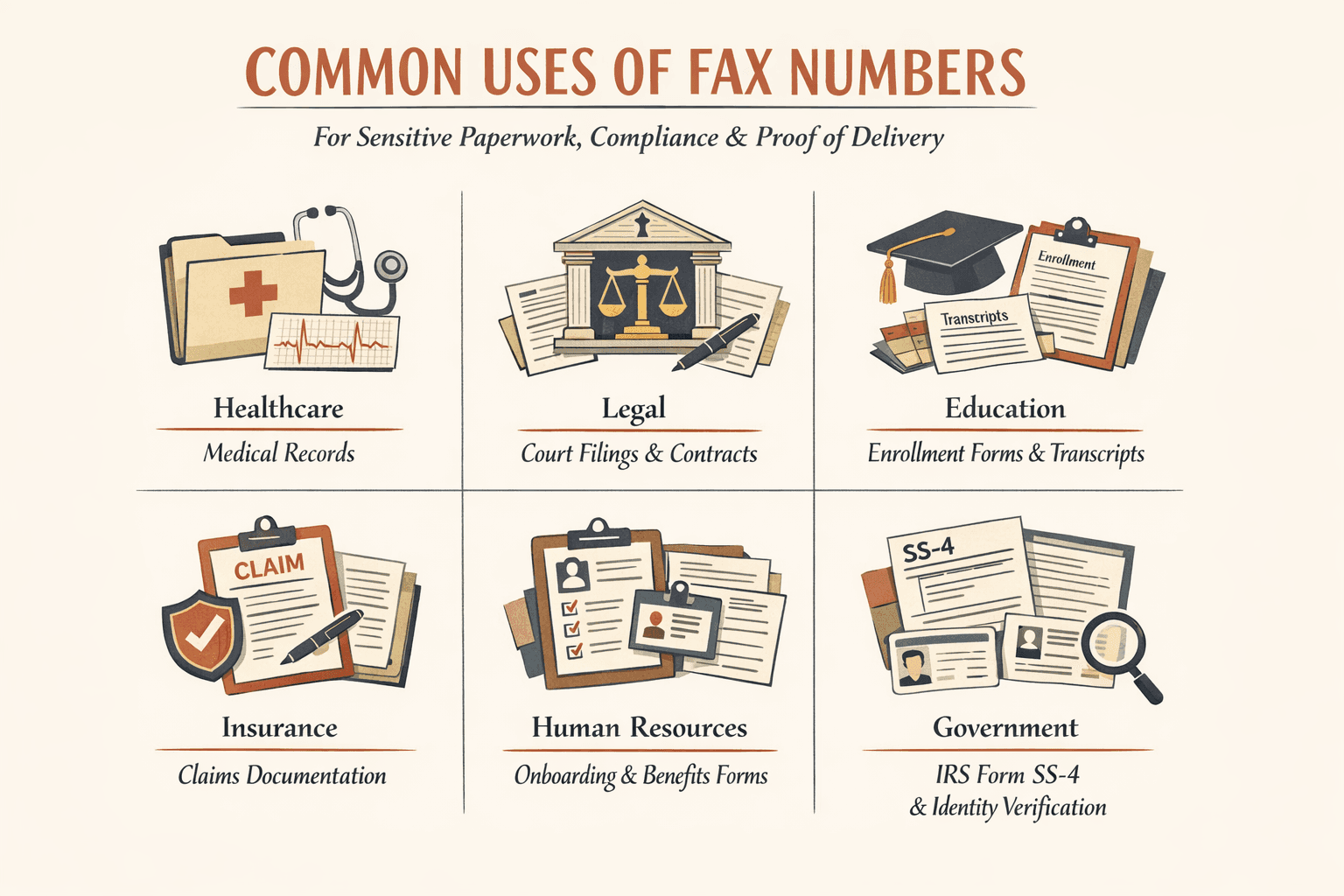
Here’s the thing: fax numbers still matter in 2026. Medical offices use them for patient records. Law firms rely on them for filing court documents. Schools need them for enrollment forms. Even the IRS accepts certain tax forms by fax for faster processing.
What Is a Fax Number?
A fax number is a unique telecommunications identifier—formatted exactly like a phone number—that routes incoming document transmissions to a receiving device or service. When someone sends you a fax, they dial your fax number the same way they’d dial a regular phone number.
The format follows standard telephony conventions: +1 (555) 123-4567 in the US, for example. The difference? Instead of connecting to a phone for conversation, the number connects to equipment (or software) designed to receive and decode document data.
Modern fax numbers don’t require physical fax machines anymore. Online fax services receive transmissions as electronic messages—basically email for faxes—without ever touching paper. You get assigned a fax number when you sign up, and incoming faxes land in your inbox as PDFs.

Key characteristics of fax numbers:
- Standard phone number format — Country code, area code, local number (e.g., +1-415-555-0199)
- Assignment process — Issued by telecom carriers (for physical machines) or online fax providers (for virtual numbers)
- Dedicated vs. shared lines — Some numbers handle only faxes; others can receive both fax and voice calls depending on the signal
- Virtual fax numbers — Cloud-based services like eFax and Fax.Plus assign internet-connected numbers that receive faxes digitally
What Is a Fax Number Used For?
Fax numbers are used to receive documents that require secure transmission, compliance with industry regulations, or simple proof of delivery. Industries that handle sensitive paperwork—healthcare, legal, government, education, insurance—still rely on fax numbers daily.
HHS explicitly permits healthcare providers to share protected health information by fax for treatment purposes with reasonable safeguards. That’s why every medical office has a fax number on file.
Common scenarios where fax numbers are used:
- Medical records transmission — Doctors fax test results, referrals, and patient charts between offices
- Legal document filing — Law firms submit court filings, contracts, and discovery materials by fax
- School enrollment forms — Parents send immunization records, transcripts, and permission slips to school fax numbers
- Insurance claims — Claim forms, medical bills, and supporting documentation go to insurer fax numbers
- HR documentation — Employee onboarding paperwork, benefits enrollment, and background check authorizations
- Government agency requests — The IRS accepts Form SS-4 and identity verification documents by fax
What Does a Fax Number Mean?
“Fax number” refers to the routing address where a document is delivered via facsimile transmission. The word “fax” is short for “facsimile”—literally meaning “exact copy”—and that’s exactly what you’re sending: a digital replica of a document.
Think of a fax number like an email address for documents. When you send an email, you type in an address and the message routes to that recipient’s inbox. When you send a fax, you dial a number and the document routes to that recipient’s fax machine or online fax account.
The term “fax number” and “phone number” are related but distinct. A fax number looks like a phone number—same format, same dial pattern—but the receiving endpoint is configured to decode document data instead of handling voice conversations. Online fax services receive faxes as electronic messages, similar to email, even though the sender dials what appears to be a standard phone number.
What Is a Fax Phone Number?
“Fax phone number” is just another way of saying “fax number.” People use this term when referring to a fax number that looks and functions like a telephone number—which is every fax number.
Some older systems use dual-purpose lines where one number handles both voice calls and fax transmissions. The system detects the type of incoming signal (voice or fax handshake tones) and routes it accordingly. These shared lines are rare today—most fax numbers are dedicated specifically to document transmission—but they explain why you’ll occasionally hear “fax phone number” used interchangeably with “fax number.”
How Do Fax Numbers Work?
When someone sends you a fax, here’s what happens: they dial your fax number, the receiving device or service answers, both sides exchange protocol signals (the “handshake”), and the document data gets transmitted and reconstructed on your end. The whole process takes 1-3 minutes for a typical document.
Step-by-step breakdown:
- Sender inputs recipient fax number (1 minute): You enter the fax number into your fax machine, online fax service, or fax app—just like dialing a phone number.
- Connection is established (10-15 seconds): The call routes through the phone network (traditional fax) or internet (online fax). Your fax number’s receiving device picks up automatically.
- Handshake protocol occurs (5-10 seconds): Sending and receiving devices exchange signals to confirm compatible transmission speeds and encoding formats. You’ll hear high-pitched tones if you’re using a physical fax machine.
- Document is encoded and transmitted (1-2 minutes): The sender’s device converts the document into audio tones (traditional fax) or data packets (online fax) and transmits page by page.
- Receiving device decodes the transmission (real-time): Your fax machine or online service decodes the incoming data and reconstructs the document—either printing it automatically or storing it as a digital file.
- Confirmation is sent back (5 seconds): Once transmission completes, your device sends a delivery confirmation signal to the sender, who receives a confirmation page or notification.

The big difference today: traditional fax uses telephone lines and audio modems, while modern online fax uses internet connectivity and delivers faxes digitally. Online fax services can’t print unless connected to user equipment—they receive and store faxes as electronic messages instead.
What Is a Fax Number for a School?
A school fax number is used by educational institutions to receive enrollment forms, immunization records, permission slips, transcripts, and other documents from parents, students, or other schools. It’s the official intake channel for paperwork that can’t or shouldn’t be handled by email.
Schools typically list their fax number on websites, registration packets, and official letterhead. If you’re enrolling your child or transferring records, you’ll send documents to the school’s fax number rather than emailing sensitive information. Many school districts still rely on fax for records transfer between institutions because it creates a clear transmission record.
That said, many schools now use secure digital transcript systems for postsecondary admissions and transfers—but the fax number remains a fallback option for forms and documents that don’t fit those workflows.
What Does “Fax No Printer” Mean?
“Fax no printer” refers to receiving faxes digitally without automatically printing them. This is the default mode for online fax services and many modern fax machines with memory storage.
When a fax arrives with “no printer” configured, it’s saved as a digital file—usually a PDF—that you can view, download, forward, or print manually if needed. Online fax services receive faxes as electronic messages that users can delete without printing at all.
Why this matters: less paper waste, lower supply costs, and the ability to review incoming faxes before deciding whether to print. It’s a core feature of paperless workflows in businesses that have moved away from physical document storage.

What Is My Fax Number?
Your fax number depends on what type of fax service or equipment you’re using. Here’s how to find it:
- Check the fax machine display or settings menu — Most machines show the assigned fax number on the control panel or in the setup menu
- Look at a fax confirmation page — Send a test fax to yourself or another number; the confirmation page will display your outbound fax number
- Log into your online fax service account — Services like eFax, Fax.Plus, and ThirtyFax display your assigned fax number in the account dashboard or settings
- Review account setup emails — When you first signed up for an online fax service, the welcome email likely included your fax number
- Contact your fax service provider or IT administrator — If you’re using a corporate system or shared fax line, your IT team can provide the number
If you’re using an online fax service like ThirtyFax, you don’t get a dedicated fax number for receiving—you’re only sending faxes. Services like ThirtyFax are designed for one-time sending with no subscription, so there’s no receiving setup involved. For regular faxing and a dedicated receive number, you’d need a subscription service like eFax or Fax.Plus.

Written by
Bernard Bado
I created ThirtyFax after needing to send a single fax and refusing to pay for a monthly subscription to do it. I write here about faxing, document workflows, and the surprisingly stubborn role fax still plays in modern business.
View author profile