
Why Do People Still Use Fax Machines in 2026?
Fax machines aren't obsolete—healthcare, legal, government, and finance sectors rely on them for regulatory compliance, embedded workflows, and simpler security than email requires.
Quick Verdict
Yes, people still use fax machines in 2026, and not just occasionally. Fax remains the standard in healthcare, legal, government, and finance sectors, driven by regulatory compliance requirements, perceived security advantages, and deeply embedded workflows that haven’t caught up with modern alternatives.
Are Fax Machines Still Used?
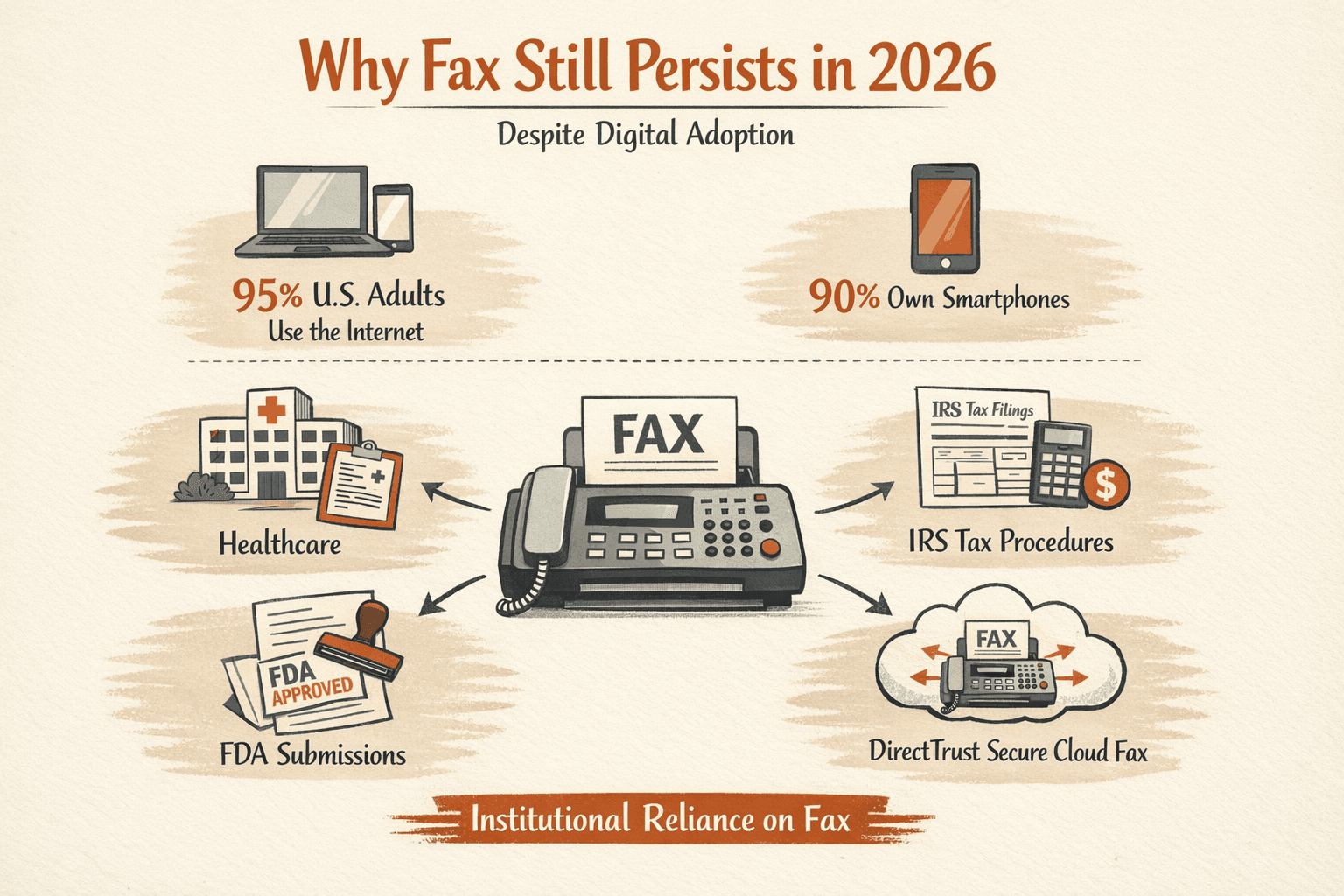
Yes. Fax machines and fax technology are actively used across multiple industries in 2026. While 95% of U.S. adults use the internet and 90% own smartphones, fax persists not because digital alternatives are unavailable, but because compliance frameworks and legacy infrastructure keep it in place.
Here’s the current state of fax usage:
- Healthcare providers routinely fax patient records between physicians, labs, specialists, and nursing homes for treatment purposes
- The IRS still accepts faxed tax forms when online submission isn’t an option, updated as recently as April 2026
- DirectTrust launched an Interoperable Secure Cloud Fax standards initiative in 2024—evidence the technology remains relevant enough to warrant new industry standards
- The FDA maintains operational procedures for accepting faxed regulatory submissions from food and drug manufacturers
Who Still Uses Fax Machines?
Fax usage concentrates in regulated industries where compliance requirements, legal workflows, and legacy infrastructure intersect. According to DirectTrust, the sectors making heavy use of fax include healthcare, finance, insurance, real estate, manufacturing, and government.
Here’s who’s still faxing regularly:
- Healthcare providers — Hospitals, clinics, pharmacies, and labs fax patient records, prescriptions, and referrals because HIPAA allows it and EHR interoperability remains incomplete
- Legal firms — Attorneys fax contracts, court filings, and discovery documents where faxed signatures carry the same legal weight as originals in many jurisdictions
- Government agencies — Federal and state offices accept faxed forms for tax authorizations, benefits applications, and regulatory submissions. The IRS still tells taxpayers to fax authorization forms when online options aren’t available
- Financial institutions — Banks, credit unions, and investment firms fax loan documents, account authorizations, and compliance paperwork to meet regulatory standards
- Real estate professionals — Agents and title companies fax purchase agreements, disclosure forms, and closing documents, though e-signature adoption is accelerating
- Insurance companies — Claims adjusters and underwriters fax policy documents, medical records requests, and authorization forms
- Manufacturing and logistics — Companies fax purchase orders, shipping manifests, and supplier contracts where B2B systems aren’t integrated

Why Are Fax Machines Still Used?
Fax persists because of a gap between available technology and institutional inertia. Organizations that could use email, cloud document sharing, or API-based integrations instead stick with fax because regulatory acceptance, workflow integration, and perceived security make it the path of least resistance.
Regulatory Compliance Requirements
Many regulated industries face compliance frameworks written when fax was the dominant secure communication method. Those rules haven’t been updated to explicitly favor modern alternatives—so fax remains the safe default.
HIPAA, the regulation governing healthcare privacy, explicitly permits providers to share patient information by fax for treatment purposes with reasonable safeguards. The regulations don’t mandate fax, but they clearly accept it—and they require more deliberate security controls for email and electronic systems.
Key regulatory frameworks that still accommodate fax:
- HIPAA Privacy and Security Rules — Allow healthcare providers to fax protected health information for treatment with reasonable safeguards like confirming recipient numbers and securing machine locations
- Telephone Consumer Protection Act — Federal law that explicitly regulates fax communications, showing fax remains a legally recognized channel
- IRS tax filing procedures — Accept faxed authorization forms when online submission isn’t viable
- FDA regulatory submissions — The agency accepts faxed registrations and filings from food and drug manufacturers where waivers apply
New regulations like CMS’s Interoperability and Prior Authorization Final Rule, which took effect January 1, 2026, are pushing healthcare toward API-based data exchange—but implementation is gradual, and fax remains compliant in the interim.
Legal Validity and Signatures
Fax transmissions carry legal weight in many jurisdictions because they produce verifiable transmission records and can include ink signatures that were physically signed before scanning. This gives fax a procedural advantage over email in contexts where wet signatures are still expected.
The IRS, for example, accepts electronic signatures for online submissions but requires wet ink signatures on faxed or mailed forms—making fax a natural fit for paper-based signature workflows. HHS guidance confirms that covered entities may accept faxed copies of signed requests for patient records, treating faxed signatures as procedurally valid.
Legal advantages fax holds in some contexts:
- Established case law — Decades of court precedents recognize faxed contracts and signatures as valid
- Transmission confirmation — Fax machines generate receipts with date, time, and recipient number, creating a built-in audit trail
- Procedural acceptance — Many government agencies and courts accept faxed filings where email would require additional authentication steps
That said, this advantage is shrinking. The FDA now accepts digital signatures in many contexts, and e-signature platforms have become mainstream in real estate, where the National Association of Realtors notes that clients no longer tolerate being asked to fax purchase agreements.

Perceived Security Advantages
Organizations often believe fax is more secure than email—not because it objectively is, but because fax workflows are simpler to execute correctly.
Fax operates over dedicated phone lines or controlled internet connections, creating point-to-point transmission that feels inherently private. Email, by contrast, relies on complex configurations—encryption protocols, secure servers, access controls—that require deliberate implementation. HHS guidance notes that while unencrypted email is not prohibited under HIPAA, it requires reasonable safeguards and may be unacceptable to some patients. That ambiguity makes fax the safer default.
Perceived security advantages driving continued fax use:
- No internet exposure — Traditional fax machines never touch the public internet, eliminating phishing, malware, and most cyberattack vectors
- Difficult to intercept — Point-to-point phone line transmission is harder to intercept than email routed through multiple servers
- Automatic confirmation — Fax machines generate transmission receipts immediately, removing delivery uncertainty
- Physical access required — Receiving a fax typically requires physical presence at the machine, reducing unauthorized access risk
But modern reality is more nuanced. DirectTrust’s 2024 initiative to develop secure cloud fax standards with identity assurance and federated security shows that the industry itself recognizes traditional fax security as incomplete. Email, when configured properly following NIST email security guidelines, can match or exceed fax security—but “configured properly” is the friction point that keeps organizations defaulting to fax.
Legacy Infrastructure and Workflow Integration
Fax survives because it’s already woven into existing systems, staff training, and business processes. Replacing it requires more than adopting new technology—it requires redesigning workflows, retraining teams, and often replacing or integrating incompatible software systems.
DirectTrust’s secure cloud fax initiative explicitly aims to modernize fax-heavy industries without disruptive and transformative changes to existing workflows and infrastructure. That framing reveals the core problem: organizations need fax to evolve, not disappear, because wholesale replacement is too disruptive.
Healthcare is the clearest example. McKinsey’s 2025 report on healthcare interoperability explains that seamless data exchange across EHR systems remains challenging—so providers still fax records between organizations that can’t share data directly. CMS’s prior authorization rule, which took effect January 1, 2026, is designed to fix that problem, but implementation is just beginning.
Practical reasons organizations haven’t transitioned away:
- Sunk infrastructure costs — Businesses that already own fax machines or subscribe to fax services face no marginal cost per transmission
- Staff familiarity — Employees know how to fax; retraining for new systems takes time and introduces errors during transition
- Integrated record-keeping — Many organizations have decades of faxed documents in their archives, and fax integrates cleanly with those paper-centric processes
Why Do Doctors Still Use Fax?
Doctors fax because healthcare data exchange remains fragmented. While EHR systems theoretically enable digital sharing, in practice many providers still can’t exchange records seamlessly—so they fax instead.
HHS explicitly permits healthcare providers to fax patient information for treatment purposes, giving examples like labs faxing test results to physicians, physicians faxing records to specialists, and hospitals faxing discharge instructions to nursing homes. These workflows are HIPAA-compliant with basic safeguards—confirming the recipient fax number and placing the machine in a secure location.
Healthcare-specific reasons doctors still fax:
- HIPAA compliance — Fax is explicitly permitted under HIPAA with minimal safeguards, while email requires encryption or patient consent for unencrypted transmission
- EHR interoperability gaps — Different EHR systems often can’t exchange data directly, and healthcare interoperability remains a work in progress
- Insurance authorization workflows — Payers and providers still use fax for prior authorizations and claims documentation, though CMS’s 2026 interoperability rule aims to change that
- Pharmacy communication standards — Many pharmacies accept prescriptions and refill authorizations via fax as a standard channel
- Cross-organization referrals — When referring patients to specialists at different health systems, fax often works when direct EHR integration doesn’t
DirectTrust’s launch of a healthcare-focused secure cloud fax standards initiative in 2024 shows that healthcare’s reliance on fax is significant enough to justify new interoperability standards rather than simply phasing the technology out.

Why Do Companies Still Use Fax?
Companies fax when dealing with partners, vendors, or government agencies that require or strongly prefer it. In B2B transactions, you adapt to your counterparty’s systems—and if they accept fax, you fax.
DirectTrust identifies finance, insurance, real estate, manufacturing, and government as industries still making heavy use of fax. The IRS, for example, still tells businesses and individuals who can’t use online options to fax authorization forms for tax matters. The FDA accepts faxed food facility registrations where applicable waivers apply.
Business scenarios where fax remains standard:
- Purchase orders and invoices — Many vendors and suppliers accept orders via fax, especially in manufacturing and wholesale distribution
- Contracts and agreements — Legal departments and procurement teams fax signed contracts where counterparties prefer or require it
- Financial documents — Banks, lenders, and accounting firms fax loan applications, tax forms, and financial statements for audit trails
- Government filings — Regulatory submissions, permit applications, and compliance documents often accept fax as an official submission channel
If you need to send a one-time business fax—say, a signed contract to a vendor who insists on it—ThirtyFax is the fastest option. No account, no subscription, just pay once and send.
Why Fax Instead of Email?
Organizations choose fax over email when regulatory acceptance is clearer, delivery confirmation is more reliable, or the recipient’s email security practices are unknown.
HHS confirms that both fax and email are permitted for healthcare treatment communications under HIPAA, provided reasonable safeguards are applied. But while fax safeguards are straightforward—confirm the number, secure the machine—email safeguards require encryption, access controls, and often patient consent for unencrypted messages. That difference makes fax operationally simpler.
| Factor | Fax | |
|---|---|---|
| Legal standing | Decades of case law; widely accepted | Increasingly accepted, but varies by jurisdiction |
| Regulatory acceptance | Explicit HIPAA permission with minimal safeguards | Permitted but requires encryption or patient consent |
| Security perception | Point-to-point, offline transmission | Requires deliberate configuration per NIST guidelines |
| Delivery confirmation | Automatic transmission receipts with timestamps | Requires read receipts or third-party confirmation services |
| Audit trails | Built-in confirmation pages | Depends on email system logging and retention policies |
The FDA’s acceptance of digital signatures shows that in many regulated contexts, modern electronic workflows can now match fax on legal validity. Email is viable—but only when both sender and recipient have implemented proper security controls.
Do Fax Machines Still Exist?
Yes, physical fax machines exist and remain in active use. HHS guidance on physician office fax procedures specifically references securing the fax machine’s physical location, confirming physical devices are still part of current compliance workflows.
But fax technology in 2026 takes multiple forms:
- Traditional standalone fax machines — Dedicated devices connected to phone lines, still common in medical offices and legal firms
- Multifunction printers with fax capability — Office printers that include fax as one function alongside printing, scanning, and copying
- Cloud-based online fax services — Digital services like eFax, Fax.Plus, and RingCentral Fax that send and receive faxes entirely over the internet with no physical machine required
DirectTrust’s 2024 cloud fax standards initiative is evidence that fax is evolving toward cloud-based implementations rather than disappearing entirely. The FDA maintains operational procedures for receiving faxes, showing government agencies continue to support the technology institutionally.

Conclusion
Fax remains in use in 2026 not because it’s technologically superior, but because regulatory acceptance, perceived security advantages, and embedded workflows make it the path of least resistance for organizations in healthcare, legal, government, and finance sectors. HIPAA explicitly permits fax with minimal safeguards, while email and API-based alternatives require more deliberate security configurations.
The transition to digital alternatives is real but gradual. CMS’s prior authorization interoperability rule began pushing healthcare toward API-based exchange in January 2026, and DirectTrust’s secure cloud fax standards aim to modernize rather than eliminate fax workflows. Fax is evolving from standalone machines to cloud services—but it’s not disappearing anytime soon.
Frequently Asked Questions
Does Anyone Use Fax Anymore?
Yes. Fax usage remains widespread enough that DirectTrust launched new industry standards for secure cloud fax in 2024, and federal agencies like the IRS continue to accept faxed forms in current procedures.
Do People Still Use Fax?
Yes. Fax persists in 2026 primarily in regulated industries where compliance requirements, legal validity, and embedded workflows make it the path of least resistance compared to digital alternatives.
Why Does Fax Still Exist?
Fax exists because regulatory frameworks written when fax was the secure standard haven’t been updated to favor modern alternatives, and cross-organization data exchange—particularly in healthcare—remains incomplete. McKinsey’s 2025 interoperability report confirms seamless digital exchange is still a work in progress.
Why Do People Still Use Fax?
People use fax because it carries legal validity, generates transmission records, and satisfies HIPAA and other regulatory requirements with minimal procedural overhead compared to configuring secure email systems.
Do Companies Still Use Fax Machines?
Yes. Companies in finance, insurance, manufacturing, and regulated sectors continue to use fax machines for vendor communications, government filings, and partner transactions where fax remains the accepted standard.

Written by
Bernard Bado
I created ThirtyFax after needing to send a single fax and refusing to pay for a monthly subscription to do it. I write here about faxing, document workflows, and the surprisingly stubborn role fax still plays in modern business.
View author profile