
Is Fax Secure? Encryption, Safety & Privacy
Traditional fax machines send unencrypted signals over phone lines—vulnerable to interception and physical breaches. Online fax encrypts data with TLS and AES-256, but security depends on your provider's implementation.
Quick Verdict
Fax security depends entirely on which method you use. Traditional fax machines send unencrypted analog signals over phone lines, making them vulnerable to interception and physical security breaches. Online fax services, on the other hand, can be highly secure when they use proper encryption and access controls—though not all providers offer the same level of protection.
This matters because businesses in healthcare, legal, and finance still transmit sensitive documents by fax daily, and regulators continue to allow faxing under HIPAA and similar frameworks—as long as you implement reasonable safeguards.
What Is a Secure Fax
A secure fax transmission protects document confidentiality from the moment you hit send until the recipient retrieves it. The key difference: encrypted methods protect data in transit and at rest, while unencrypted methods (like traditional fax machines) don’t.
Here’s what defines secure fax transmission:
- End-to-end or transport-layer encryption — Data is scrambled during transmission using standards like TLS or AES-256, preventing interception
- Access controls — Only authorized users can send, receive, or view faxed documents through password protection and role-based permissions
- Audit trails — Complete logs of who sent what, when, and to whom for compliance and security reviews
- Secure storage — Documents are encrypted at rest, not sitting in plain text on a server or in an output tray
- Compliance certifications — HIPAA-ready infrastructure with signed Business Associate Agreements (BAAs) when handling protected health information
| Method | Encryption Status | Vulnerability Points | Compliance Capability |
|---|---|---|---|
| Traditional Fax Machine | None (analog signal) | Phone line interception, unsecured output trays, physical access, no transmission logs | Limited—relies entirely on physical safeguards |
| Online Fax Service | TLS/AES-256 available (provider-dependent) | Account compromise, weak passwords, insecure storage settings | High—BAAs, audit logs, encryption at rest available from compliance-focused providers |
Traditional fax offers no technical encryption. Online fax can be secure, but only if the provider implements encryption properly and you configure access controls correctly.

How Secure Is Fax
The answer splits cleanly between two completely different technologies.
Traditional Fax Machine Security
Traditional fax machines are not secure by modern standards. They transmit documents as unencrypted analog signals over standard phone lines, leaving them vulnerable to interception at multiple points. Physical security issues compound the problem—faxes sit in output trays where anyone walking by can grab them.
Here are the specific vulnerabilities:
- No transmission encryption — Phone line taps can capture the entire fax in transit
- Unsecured output trays — Printed documents are accessible to anyone near the machine
- No access logs — You can’t track who sent or retrieved a fax
- Physical document risks — Paper copies create disposal and storage security challenges
- Misdial errors — One wrong digit sends sensitive information to a stranger’s fax machine
- No recipient authentication — You can’t verify who actually retrieved the fax on the other end
The only security measures available are physical: placing machines in locked rooms, verifying destination numbers before sending, and establishing document retrieval procedures.

Online Fax Security
Online fax services transmit documents over the internet rather than phone lines, which allows for much stronger security controls. When properly configured, these services encrypt data in transit and at rest, maintain detailed access logs, and offer compliance certifications that traditional fax machines can’t match.
Security advantages of online fax include:
- End-to-end encryption — TLS during transmission and AES-256 for stored documents (on compliant platforms)
- Granular access controls — Role-based permissions determine who can send, receive, and view specific faxes
- Complete audit trails — Detailed logs track every transmission, access, and action for compliance reviews
- Multi-factor authentication — Protects accounts from credential theft
- Business Associate Agreements — HIPAA-ready providers sign BAAs and maintain compliant infrastructure
Not all online fax providers are equally secure, though. Free consumer tools may lack encryption, while enterprise platforms offer HIPAA compliance and enterprise-grade controls. Before choosing a service, verify it offers encryption both in transit and at rest, provides signed BAAs if you handle regulated data, and supports strong authentication methods.

What Protective Measures Should Be Taken for Fax Machines
Security measures differ dramatically between traditional and online fax methods.
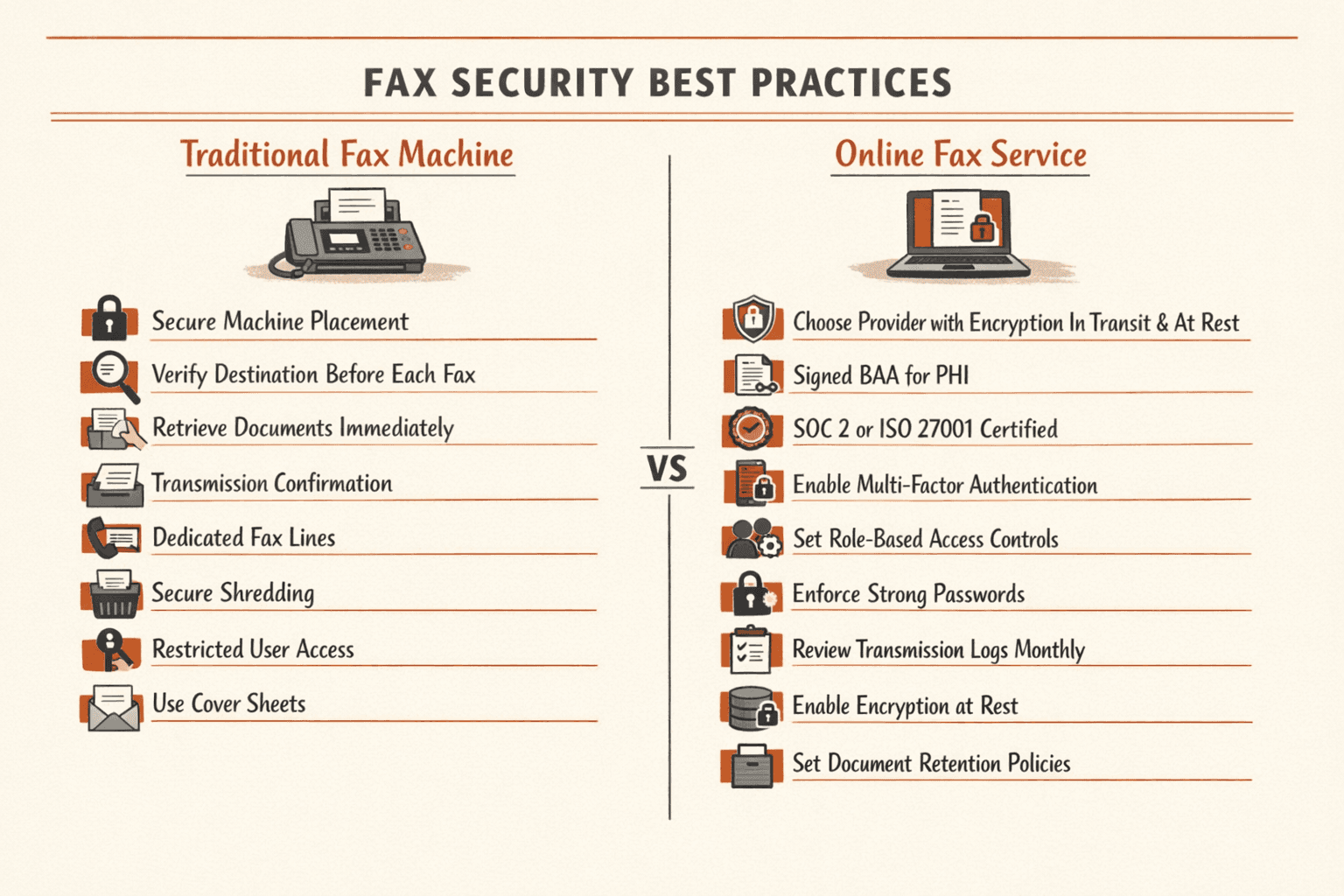
Traditional Fax Machine Protective Measures
Traditional fax machines require strict physical and operational controls because they offer no technical security safeguards:
- Secure machine placement (ongoing) — Place fax machines in locked rooms with restricted access, not in public hallways or open reception areas.
- Destination verification before transmission (every fax) — Confirm the recipient’s fax number directly by phone before sending sensitive documents. One wrong digit compromises the entire transmission.
- Immediate document retrieval (within minutes) — Assign staff to retrieve incoming faxes immediately. Every minute a document sits in an output tray is a potential breach.
- Transmission confirmation protocols (every fax) — Review transmission reports to confirm successful delivery, but remember these only verify the destination machine received data—not who actually retrieved the printout.
- Dedicated fax lines (one-time setup) — Use separate phone lines for fax to prevent accidental number disclosure and simplify access controls.
- Secure document disposal (ongoing) — Shred unsuccessful transmissions and outdated faxes rather than tossing them in standard trash bins.
- Access restriction policies (quarterly review) — Limit who can send and retrieve faxes. Fewer authorized users mean fewer potential security failures.
- Cover sheet protocols (every fax) — Include confidentiality notices and recipient instructions on every cover sheet, especially for sensitive or regulated documents.
Online Fax Protective Measures
Online fax services shift security from physical controls to digital safeguards:
- Choose a compliant provider (initial setup) — Select services that offer encryption at rest and in transit, provide signed Business Associate Agreements if you handle PHI, and maintain SOC 2 or ISO 27001 certifications.
- Enable multi-factor authentication (one-time setup) — Require at least two authentication factors—password plus SMS code, authenticator app, or hardware key. Even better: use phishing-resistant methods like passkeys where available.
- Configure role-based access controls (initial + quarterly review) — Set permissions so users can only access faxes relevant to their role. Not everyone needs full account access.
- Enforce strong password policies (ongoing) — Require complex passwords and password manager use. Change passwords immediately when employees leave.
- Review transmission logs regularly (monthly) — Check access and activity logs for unusual patterns—unexpected sending locations, off-hours access, or failed authentication attempts.
- Enable encryption at rest (initial setup) — Verify stored faxes are encrypted in your provider’s cloud storage, not sitting in plain text.
- Set document retention policies (initial + annual review) — Automatically delete faxes after a defined period rather than storing them indefinitely. Less stored data means less breach exposure.
Conduct security audits annually regardless of fax method. Review who has access, test retrieval procedures, and update protocols when staff roles change.
Frequently Asked Questions
Is Fax Secure?
It depends on the method. Traditional fax machines are not secure—they transmit unencrypted analog signals over phone lines and print documents in unsecured output trays. Online fax services can be secure when they use proper encryption, access controls, and compliance certifications, but this varies by provider. Even HIPAA permits faxing as long as you implement reasonable safeguards.
Are Fax Machines Secure?
No. Physical fax machines lack encryption, digital access controls, and audit trails. Documents print in open trays where anyone nearby can grab them, phone lines can be tapped, and there’s no way to track who sent or retrieved a specific fax. The only available protections are physical safeguards like locked rooms and immediate document retrieval.
Is Fax a Secure Way to Send Documents?
For one-time or occasional document transmission, online fax services with proper encryption offer reasonable security—often better than unencrypted email. For regular sensitive document exchange, dedicated secure file transfer systems or encrypted email with digital signatures provide stronger controls. Traditional fax machines should be avoided for any sensitive information unless you have no other option.
If you need to send a single fax without signing up for a subscription, ThirtyFax offers a no-account option with transparent pricing—€4.99 for up to 20 pages, no recurring charges.
Is Fax Encrypted?
Traditional analog fax is not encrypted—there’s no widely used encryption standard for analog fax transmission over phone lines. Online fax services may offer encryption depending on the provider and service tier. Look for platforms that use TLS 1.2 or higher for transmission and AES-256 for stored documents. Providers offering HIPAA compliance typically include encryption by default.
Is Fax Obsolete?
Fax as a transmission standard is not obsolete—it’s just moved online. Physical fax machines have declined sharply, but the fax protocol itself continues through internet-based services. Organizations that eliminated their fax machines often still “fax” documents through cloud services that convert emails or uploaded files into fax transmissions. The method changed, but the use case (point-to-point document delivery with confirmation) remains relevant in regulated industries where email alone doesn’t meet compliance requirements.
When Did Fax Machines Become Obsolete?
There’s no single cutoff date—physical fax machines declined gradually. Email adoption in the early 2000s started the shift, cloud services in the 2010s accelerated it, and by the late 2010s most businesses had eliminated their fax machines. However, “obsolete” varies by industry. Healthcare and legal services maintained fax infrastructure longer due to regulatory acceptance and established workflows.
Even now, regulators like HHS still reference fax in current guidance documents, indicating that while the hardware has declined, the transmission method itself hasn’t fully disappeared from regulated workflows.

Written by
Bernard Bado
I created ThirtyFax after needing to send a single fax and refusing to pay for a monthly subscription to do it. I write here about faxing, document workflows, and the surprisingly stubborn role fax still plays in modern business.
View author profile